Understanding Shares
A Rights Issue Letter Has Arrived. What Is the Company Asking You to Do?
By Oluwadamilola Ojo · 22 November 2026 · 4 min read
A Rights Issue Letter Has Arrived. What Is the Company Asking You to Do?
A rights issue is when a company raises new money by offering its existing shareholders the right to buy new shares, usually at a price below the current market price. The offer is made in proportion to what you already own, for example "1 new share for every 4 held".
Unlike a bonus issue, a rights issue costs money. You are being asked to put more money into the company. In return, you can keep your share of the company from shrinking.
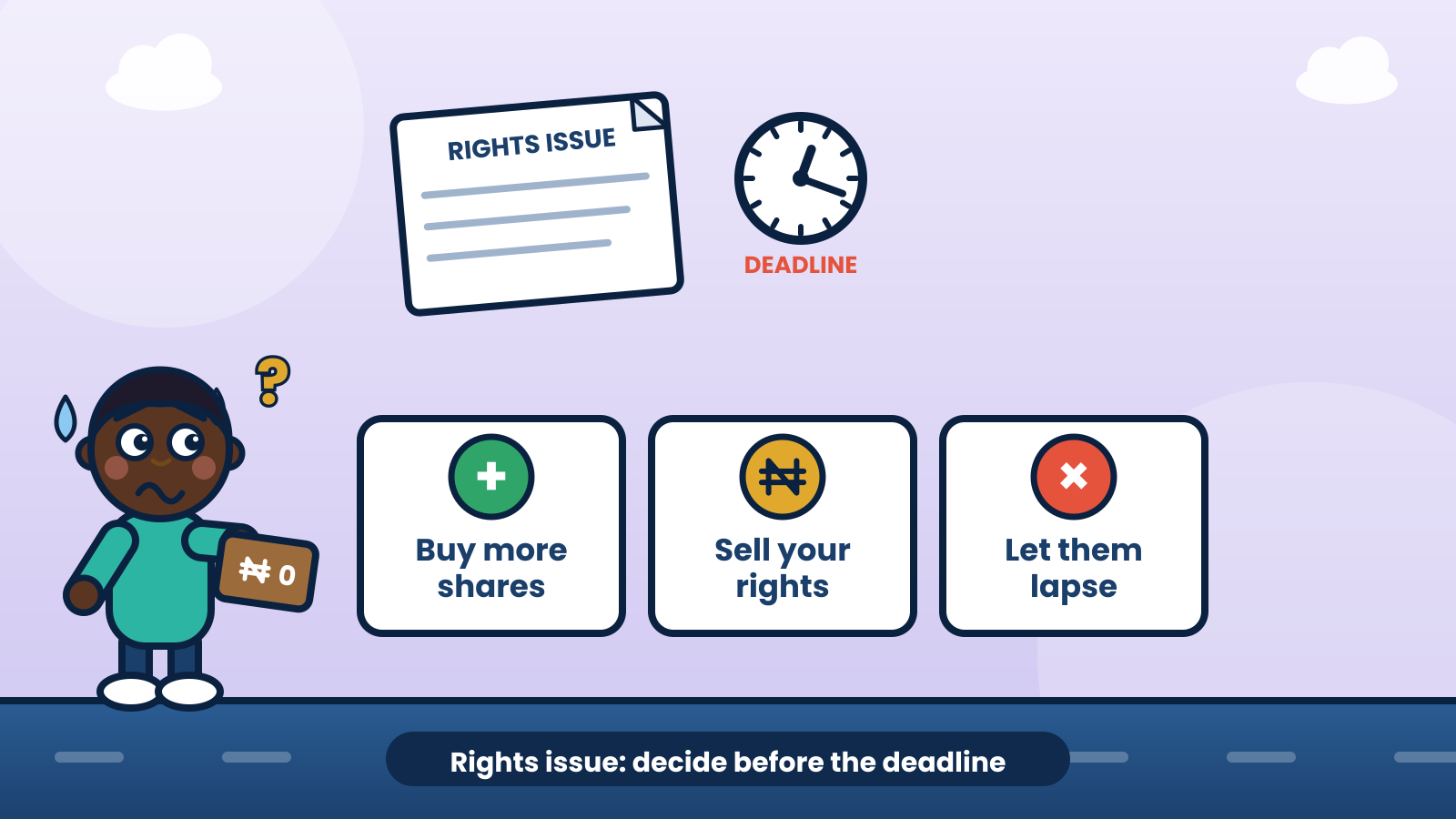
You usually have three choices:
Take up your rights. Pay for the new shares you are offered.
Sell or renounce your rights, where the rules allow it, to someone else who wants them.
Do nothing. Your rights lapse, and other shareholders or underwriters may take up the shares.
Here in Nigeria
Nigerian companies, especially banks and insurers needing more capital, have used rights issues many times, including during recent bank recapitalisation exercises. Approval from shareholders and the SEC comes first. Then each qualifying shareholder is sent a rights circular and an acceptance form showing how many new shares they can buy, the price, and the deadline. The issue usually stays open for a few weeks.
The letter is sent to the address the registrar has for you. If that address is old, you may never receive it, and you may only find out after the offer has closed. Many brokers and registrars now also allow you to accept online.
A simple example
Halima owns 8,000 shares of a made-up bank, Sunrise Bank, trading at ₦10. The bank offers 1 new share for every 4 held, at ₦8 each.
Item |
Working |
Result |
New shares offered to Halima |
8,000 ÷ 4 |
2,000 shares |
Cost to take them up |
2,000 × ₦8 |
₦16,000 |
Bank's total shares before and after |
100 million, then 125 million |
25% more shares |
Halima's share of the bank if she takes up |
10,000 of 125 million |
0.008%, unchanged |
Halima's share if she does nothing |
8,000 of 125 million |
0.0064%, smaller |
Because the new shares are sold at a discount, the share price often settles somewhere between the old price and the offer price. If Halima does nothing, she still has 8,000 shares, but they are now a smaller part of a bigger company, and each may be worth a little less. This shrinking of your share is called dilution.
Why this matters to you
A rights issue is a decision, not just information. Before you decide, ask:
Why is the company raising money? To grow, or to fix a problem such as losses or a capital shortfall?
Can you afford it, and do you want more of this company? Do not put in money you will need soon.
What happens if you do nothing? Know the deadline and the effect of letting your rights lapse.
What people often get wrong
"The new shares are cheap, so I must buy." The discount is part of how rights issues work. The real question is whether you want to invest more in this company.
"If I ignore the letter, nothing changes." Your share of the company shrinks, and the value of your holding may dip.
"A rights issue is like a bonus issue." A bonus issue is free and adds no new money. A rights issue asks you to pay.
The one thing to remember
A rights issue asks you to invest more money to keep your share of the company. Read the letter, understand why the money is needed, and decide before the deadline. |
Over to you
Have you ever received a rights issue letter? Did you take up your rights, sell them, or let them lapse, and why?