Understanding Shares
Did Your Parents Buy Shares When Government Companies Were Sold?
By Oluwadamilola Ojo · 22 November 2026 · 3 min read
Did Your Parents Buy Shares When Government Companies Were Sold?
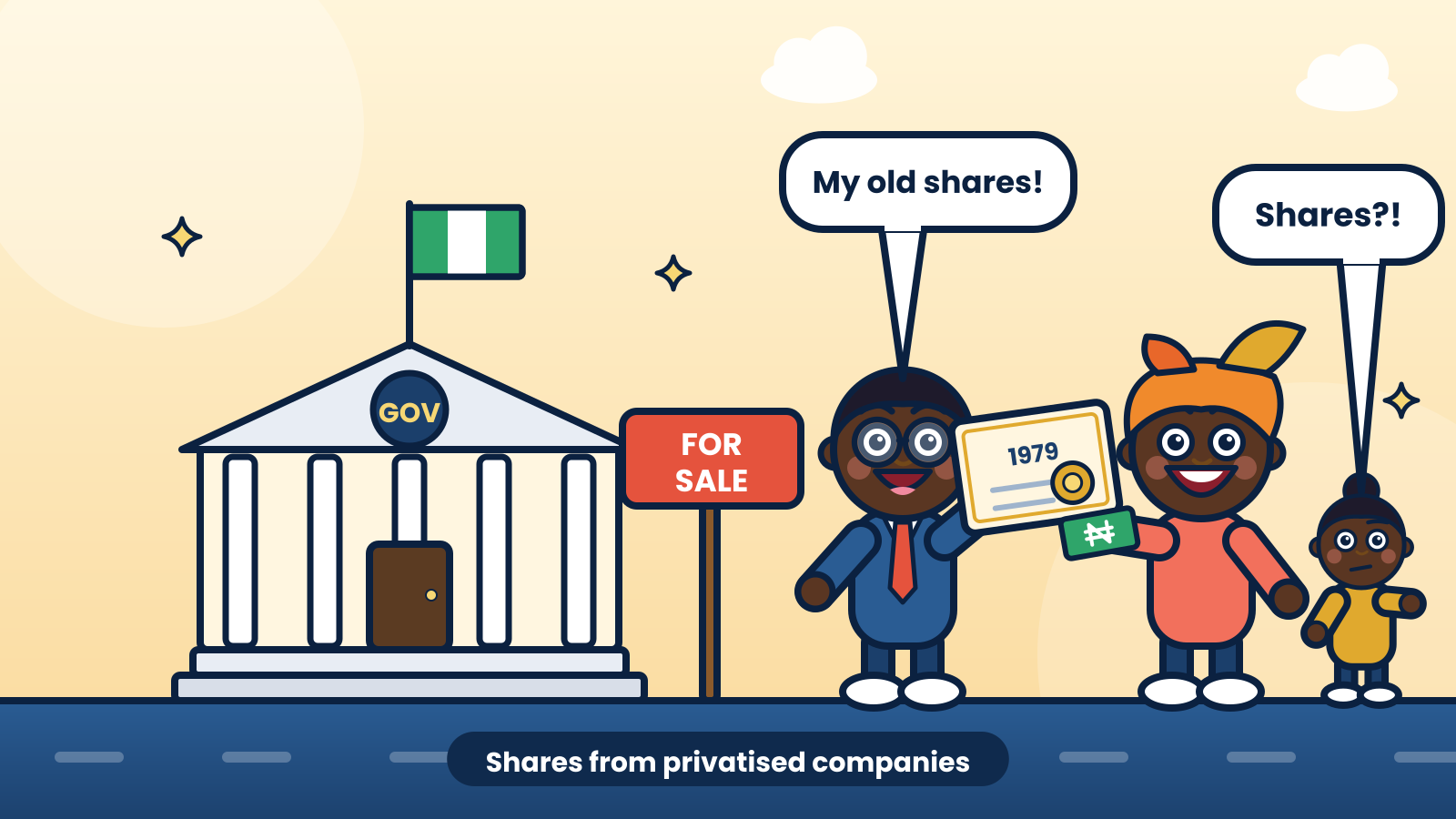
Privatisation is when the government sells companies, or parts of companies, that it owns. When this is done through the stock market, ordinary citizens can buy shares in companies that used to belong to the state.
In Nigeria, there were two major waves that put shares into ordinary people's hands: the indigenisation era of the 1970s, when foreign-owned companies were required to sell shares to Nigerians, and the privatisation programmes from the late 1980s onwards, when government sold its stakes in a range of enterprises.
For many families, these were their first ever shares. Many are still sitting on registers today, under names of people who have retired, moved or passed on.
Here in Nigeria
In the 1970s, the Nigerian Enterprises Promotion Decrees required many foreign-owned companies to sell a share of their businesses to Nigerians. Companies listed on the exchange, and civil servants, teachers, traders and professionals bought shares, often in small amounts.
From the late 1980s, under the privatisation and commercialisation programme, the government sold its holdings in several companies, including in sectors such as petroleum marketing, cement, insurance and banking. Many of these sales were designed to spread ownership widely across Nigeria, with shares allocated to people in different states. Later privatisations were handled by the Bureau of Public Enterprises.
Over the decades, many of these companies changed. Some merged, some were renamed, some were bought by larger groups, and some were delisted. A shareholding from 1978 or 1990 may have passed through several of these changes.
A simple example
Mr Nwosu, a retired teacher, bought shares in two companies decades ago. The companies and details are made up.
Holding |
Bought |
What happened since |
Possible position today |
Unity Petroleum Marketing |
1991, 1,000 shares |
Several bonus issues, then a merger into a larger energy group |
Shares in the energy group, plus dividends |
Coastline Cement |
1979, 500 shares |
Renamed, bonus issues, later bought out by its parent and delisted |
A buy-out payment may be held for him, unclaimed |
His children find a 1991 certificate and a 1979 dividend warrant. Neither company name is on the exchange today. A search with the registrars could show that one holding is now worth something on the exchange, and the other left behind a cash payment that he never collected.
Why this matters to you
Older relatives may hold shares that they bought decades ago and forgot about, or that they assumed were lost when a company changed its name. Talking to them about it, and gathering their papers while they can explain them, can be very valuable. Once a shareholder has passed away, tracing becomes slower and harder, because the family must also go through the legal process to deal with the estate.
What people often get wrong
"Those old government companies collapsed." Some did. Many continued under new names or owners.
"Shares from the 1970s cannot still be valid." If they were never sold, transferred or cancelled, they can still be on a register.
"It's too old to trace." It is harder, and records may be incomplete. But registrars keep historical records, and old documents often contain enough detail to start a search.
The one thing to remember
Shares bought during Nigeria's indigenisation and privatisation years may still exist under new company names. Talk to the older people in your family while they can still tell you the story. |
Over to you
Has an older relative ever mentioned buying shares "when the government was selling companies"? Have you asked them what they bought?