Understanding Shares
Final Dividend, Interim Dividend: Which Dates Decide Whether You Get Paid?
By Oluwadamilola Ojo · 22 November 2026 · 4 min read
Final Dividend, Interim Dividend: Which Dates Decide Whether You Get Paid?
A company that makes a profit may share part of it with shareholders as a dividend. Some companies pay once a year. Others pay twice or more.
An interim dividend is paid during the financial year, usually after the half-year results. It is a payment on account, before the full year is finished.
A final dividend is paid after the full-year results are out and the shareholders approve it at the Annual General Meeting.
Every dividend comes with a set of dates. These dates decide who gets paid and when. If you understand them, you will never again be confused about why you bought a share and did not receive the dividend everyone was talking about.
Here in Nigeria
When a Nigerian listed company declares a dividend, it publishes a notice with the key dates. You will usually see:
Declaration date. The day the board announces the dividend and how much it is per share.
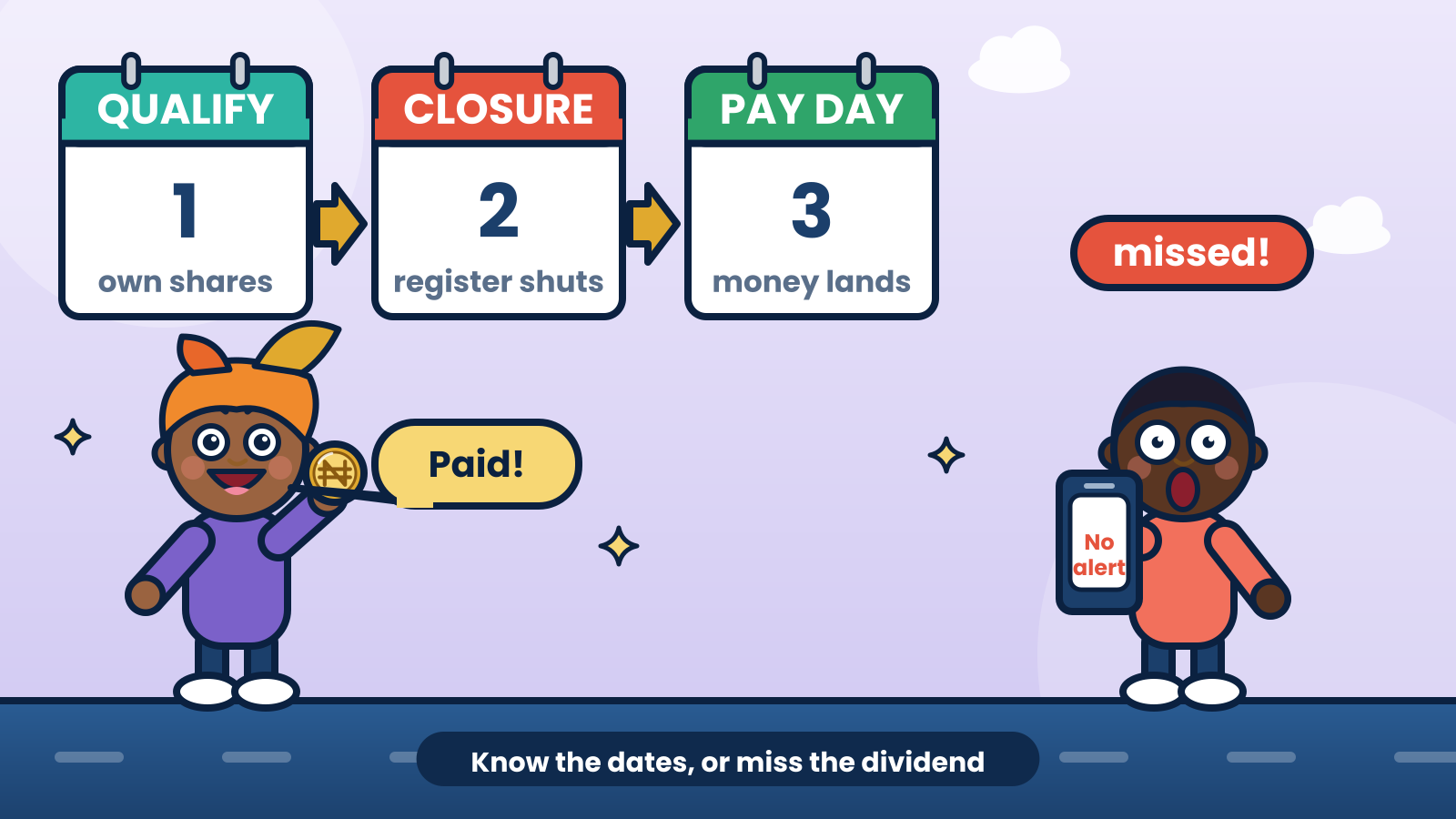
Qualification date (record date). The date the registrar checks the register. Only shareholders on the register on that date will be paid.
Closure of register. A short period after the qualification date when the register is closed so the registrar can prepare the payment list.
Annual General Meeting. For a final dividend, shareholders approve it here.
Payment date. The day the money is paid into shareholders' bank accounts.
Because of settlement, you must buy before the qualification date, early enough for your purchase to settle and appear on the register. The last day you can buy and still qualify is known in many markets as the last day of trading "with dividend". After that, the share trades ex-dividend, meaning without the right to the coming dividend. Your broker can tell you the exact cut-off.
A simple example
A made-up company, Delta Foods Plc, declares a final dividend of ₦1.50 per share. Assume a settlement cycle of two working days.
Date |
Event |
What it means for you |
Monday 3 March |
Dividend declared |
Board announces ₦1.50 per share |
Wednesday 26 March |
Last day to buy and qualify |
Buy by this day so your purchase settles in time |
Thursday 27 March |
Share goes ex-dividend |
Buy from today and you will not get this dividend |
Friday 28 March |
Qualification date |
Register checked. Everyone on it qualifies |
31 March to 4 April |
Register closed |
Registrar prepares the payment list |
Thursday 24 April |
AGM |
Shareholders approve the dividend |
Friday 25 April |
Payment date |
Money paid into bank accounts |
If you held 4,000 shares on the qualification date, you would receive 4,000 × ₦1.50 = ₦6,000, before tax. If you bought on Thursday 27 March, you would get none of it, and the person who sold to you would get it instead.
Why this matters to you
These dates explain two things that often confuse new shareholders. First, why a share price often drops on the ex-dividend day: the people buying from that day will not get the dividend, so they pay less. Second, why you can sell after the qualification date and still be paid: you were on the register when it counted.
They also explain why a correct bank account matters. On the payment date, the registrar pays into the account on file. If that account is wrong or closed, the money does not reach you, even though you qualified.
What people often get wrong
"I owned the share on payment day, so I should be paid." What matters is the qualification date, not the payment date.
"Buying just before a dividend is free money." The price usually falls by roughly the dividend amount when the share goes ex-dividend, and tax is taken from the dividend. It is not free.
"An interim dividend means the final one is guaranteed." The final dividend depends on the full-year results and shareholder approval.
The one thing to remember
To receive a dividend, you must be on the register on the qualification date, and your bank details must be correct on the payment date. The calendar decides who gets paid. |
Over to you
Have you ever bought a share expecting a dividend and not received it? Looking at these dates, can you now see why?