The Foundations
How Do Shareholders Actually Make Money?
By Oluwadamilola Ojo · 15 November 2026 · 3 min read
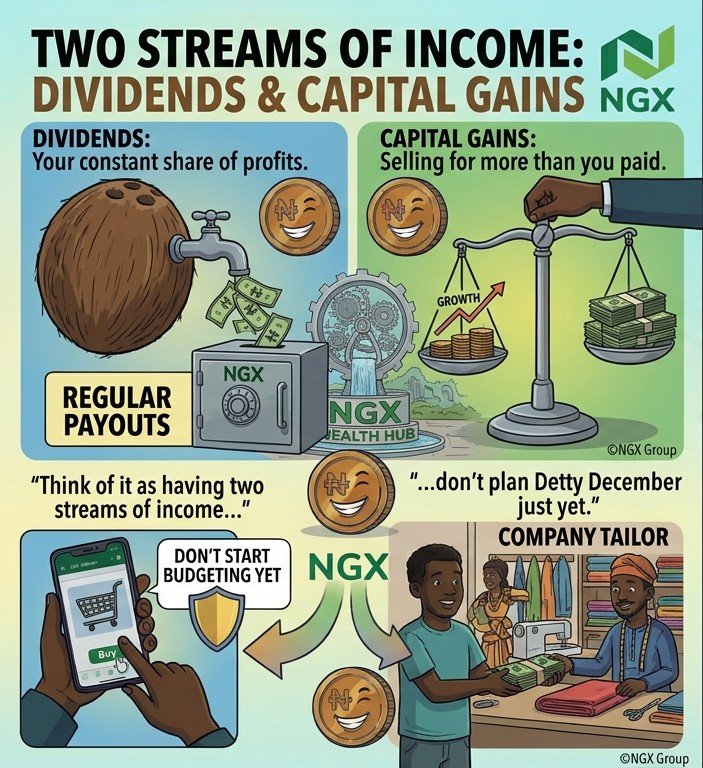
How Do Shareholders Actually Make Money?
A shareholder can earn from a share in two ways.
Price growth (capital gain). You buy at one price and sell later at a higher price. The difference is your gain.
Dividends. The company pays part of its profit to shareholders.
Both can also go the wrong way. The price can fall below what you paid, and dividends can be reduced or stopped.
Here in Nigeria
Some Nigerian investors buy mainly for regular dividends from established companies while others buy for price growth and are ready to wait. Costs apply either way: your stockbroker charges fees on each trade, there are market levies, and tax may apply to dividends and to gains. Inflation also matters. If prices in the shops rise faster than your investment grows, your money buys less than before even if the number looks bigger.
A simple example
You buy 1,000 shares at ₦10 each. That costs ₦10,000 before fees. Here are three possible outcomes. The figures are made up and shown before fees and tax.
|
Good year |
Flat year |
Bad year |
Price when you sell |
₦13 |
₦10 |
₦8 |
Gain or loss on price |
+₦3,000 |
₦0 |
−₦2,000 |
Dividend (₦1 per share) |
+₦1,000 |
+₦1,000 |
+₦1,000 |
Total before fees and tax |
+₦4,000 (40%) |
+₦1,000 (10%) |
−₦1,000 (−10%) |
Notice the bad year. The dividend softened the loss, but you still ended up behind. Notice too that the gain or loss on price only becomes real money when you sell. Until then it is a paper figure.
Why this matters to you
Before you buy, know what you are hoping for: regular income, growth, or a bit of both and know how long you can leave the money alone. And remember that fees and taxes reduce what you keep, so the profit on paper is not the profit in your pocket.
What people often get wrong
“I only make money if the price goes up.” Dividends are the other source of return.
“A dividend means I am in profit.” Not if the price has dropped by more than the dividend paid.
“My gain on screen is already mine.” It becomes yours only when you sell.
The one thing to remember
Shareholders can benefit from business growth shown in the share price and from dividends paid by the company. Both are uncertain, and you can also lose money. |
Over to you
Right now, what matters more to you: money coming in regularly, or money growing over time? How long could you leave an investment untouched?
This article is for education only and is not investment advice. Company names, prices and figures in the examples are made up to show how things work.