Understanding Shares
You Received Bonus Shares, So Why Didn't You Get Richer?
By Oluwadamilola Ojo · 22 November 2026 · 4 min read
You Received Bonus Shares, So Why Didn't You Get Richer?
A bonus issue is when a company gives its existing shareholders extra shares for free, in proportion to what they already own. You will see it written as a ratio, such as "1 for 5", which means one new share for every five you hold.
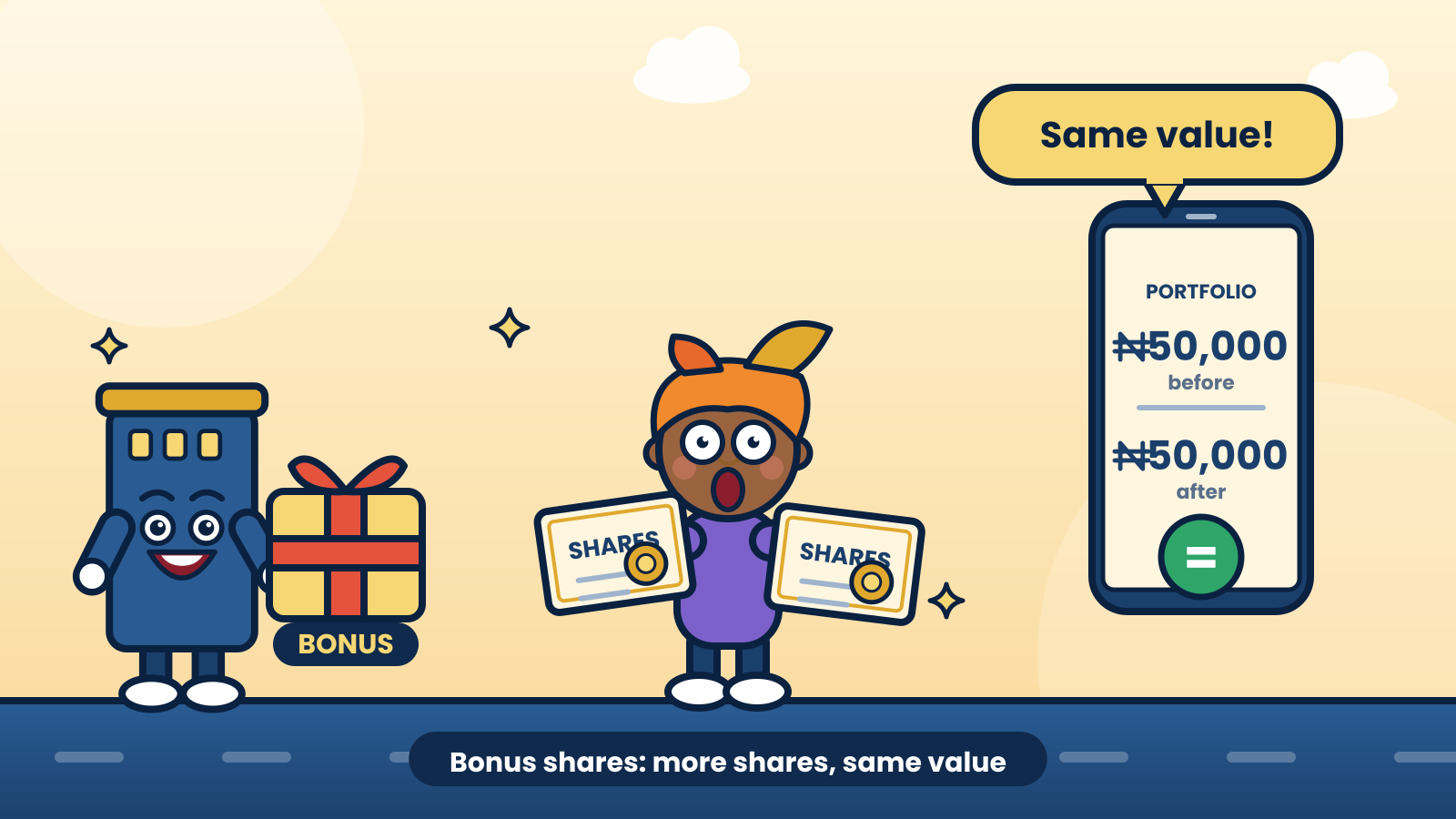
It sounds like a gift. You pay nothing, and you suddenly own more shares. But here is the important part: the company itself has not become any more valuable. No new money has come in. The same company is simply cut into more slices.
So after a bonus issue, the share price normally adjusts downwards. You own more shares, each worth less, and the total value of your holding stays about the same.
Why do companies do it? A bonus issue usually comes from turning some of the company's accumulated profits or reserves into share capital. It can be a way of rewarding shareholders without paying out cash, a signal of confidence, or a way to bring a high share price down to a level that more people can afford.
Here in Nigeria
Bonus issues are a familiar corporate action on the NGX. They are often declared alongside a cash dividend in the results announcement, and approved at the AGM. Like dividends, they have a qualification date. Bonus shares are credited to shareholders' CSCS accounts by the registrar.
This is one more reason why many Nigerians who bought shares in the 2000s own more shares today than they bought. If those shares were never dematerialised or the records are out of date, the bonus shares may also be sitting unclaimed with the registrar.
A simple example
Ifeoma owns 5,000 shares of a made-up company, Coastline Cement, priced at ₦60. The company declares a bonus issue of 1 for 5.
Item |
Before the bonus |
After the bonus |
Shares held |
5,000 |
5,000 + 1,000 = 6,000 |
Share price |
₦60 |
About ₦60 × 5 ÷ 6 = ₦50 |
Value of holding |
₦300,000 |
6,000 × ₦50 = ₦300,000 |
Company's total shares |
100 million |
120 million |
Company's value |
₦6 billion |
About ₦6 billion |
Nothing changed in her wealth on the day. Over time, there can be a benefit if the company keeps paying the same dividend per share on the bigger number of shares, because she now has 6,000 shares earning dividends instead of 5,000. But that depends on future decisions, not on the bonus itself.
Why this matters to you
Understanding bonus issues protects you from two mistakes. The first is buying a share just before a bonus issue, thinking you will get free money. The second is panicking when the price drops after the bonus, thinking you have lost value. In both cases, the arithmetic tells the real story.
After any bonus issue, check your CSCS statement to make sure the new shares have arrived. Missing bonus shares are a real and common problem.
What people often get wrong
"Bonus shares are free money." They are more slices of the same company. Your share of the company is unchanged.
"The price fell after the bonus, so the company is in trouble." The price adjustment is expected. Compare value, not price.
"Bonus shares arrive automatically, so I don't need to check." They should, but records can be wrong. Check your statement.
The one thing to remember
A bonus issue gives you more shares, but not more of the company. Your total value stays about the same. What matters is what the company does next. |
Over to you
Have you ever received bonus shares? Did you check your statement afterwards to see that they were actually credited?